
Insights · Ground dimensions
Hockey Field Dimensions
A hockey pitch is 91.40 m long and 55.00 m wide under the FIH Rules of Hockey (edition effective March 2026). The shooting circles reach 14.63 m from the goal line, the “23 m” lines are 22.90 m from each back-line, and the goals are 3.66 m wide and 2.14 m high. FIH facilities guidance recommends run-offs of 5 m at the ends and 3 m at the sides, for an overall area of 101.4 × 61.0 m.
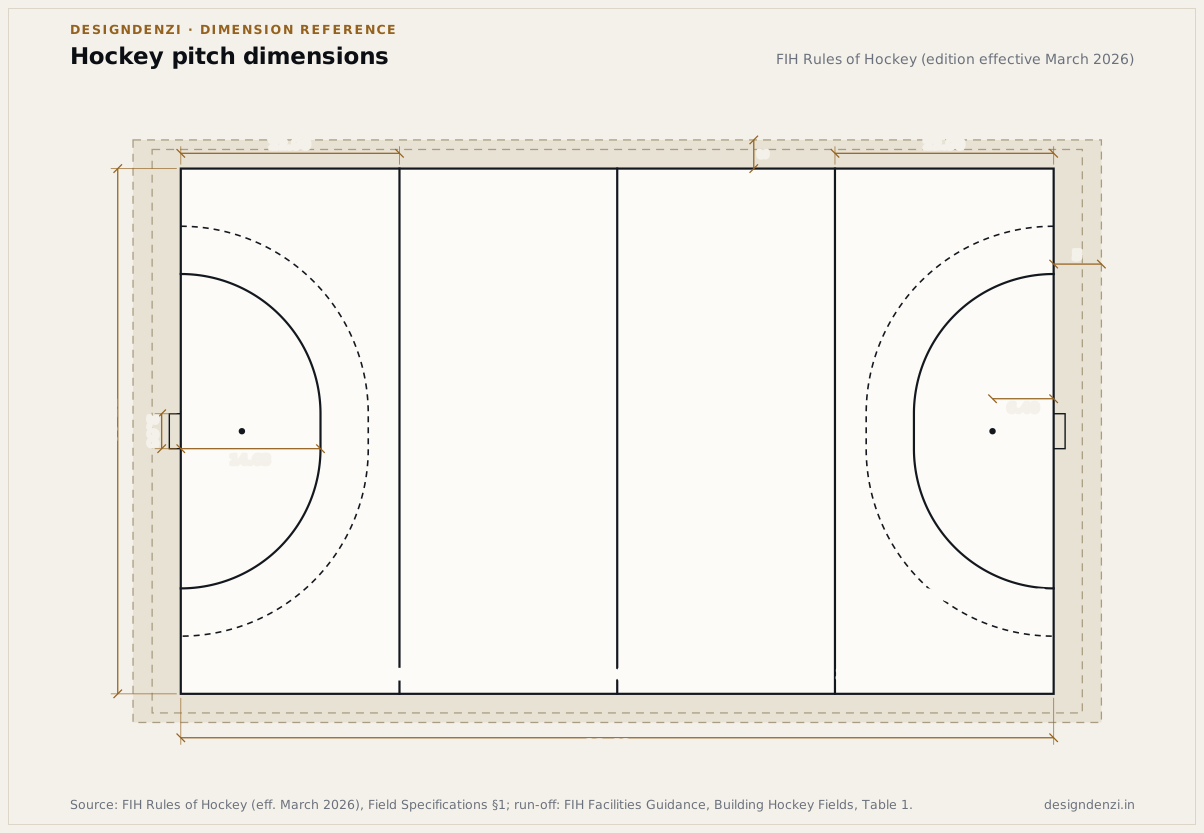
Key dimensions at a glance
| Element | Figure | Reference |
|---|---|---|
| Field | 91.40 × 55.00 m | Spec. 1.1 |
| Line width | 75 mm | Spec. 1.2 |
| “23 m” lines from each back-line | 22.90 m | Spec. 1.3(e) |
| Shooting circle | 14.63 m from the back-line | Spec. 1.4 |
| Circle straight line | 3.66 m | Spec. 1.4 |
| Dotted line outside the circle | 5 m | Spec. 1.4(d) |
| Penalty spot (centre) | 6.40 m from the inner edge of the goal-line (6.475 m from its outer edge) | Rule 1.7; Spec. 1.3(i) |
| Goal (between posts × to underside of crossbar) | 3.66 × 2.14 m | Spec. 1.5 |
| Goal depth (at crossbar / at ground) | min. 0.90 m / min. 1.20 m | Spec. 1.5 |
| Back-boards and side-boards | 460 mm high | Spec. 1.6 |
| Flag-posts | 1.20–1.50 m | Spec. 1.8 |
Spec. = Field and Equipment Specifications in the FIH Rules of Hockey; Rule = Playing the Game. The FIH works in metres only.
How the field is marked
Lines are 75 mm wide and are part of the field. The centre line and the two “23 m” lines cross the field — the 23 m lines are 22.90 m from each back-line, measured across their furthest edges. Each shooting circle is a 3.66 m straight line, parallel to the back-line with its outer edge 14.63 m from the back-line’s outer edge, joined to the back-line by quarter circles centred on the inside front corner of each goalpost. A dotted line runs 5 m outside each circle, in 300 mm dashes with 3 m gaps.
The penalty spot is 150 mm in diameter, its centre 6.40 m from the inner edge of the goal-line — 6.475 m from its outer edge, since the line is 75 mm wide. Short 300 mm marks on the back-line, 5 m and 10 m from the outer edge of the nearer post, are used to position the penalty corner.
Run-off and overall area
| Standard | Ends | Sides | Overall |
|---|---|---|---|
| Rules minimum | 2 m + 1 m clear | 1 m + 1 m clear | 97.40 × 59.00 m |
| FIH recommended | 3 m + 2 m | 2 m + 1 m | 101.4 × 61.0 m |
The Rules require the playing surface to continue at least 2 m beyond the back-lines and 1 m beyond the side-lines, with a further 1 m clear of obstructions. FIH guidance recommends the larger run-offs wherever possible and makes them mandatory for its top category of water-based fields used for international competition. Overall areas are our arithmetic.
Orientation, levels and lighting
- Orientation — roughly north–south; the 2026 World Cup specification allowed ±15°.
- Levels — ideally no more than 0.2% along the field and 0.4% across it, and never more than 1.0% in any direction.
- Lighting, non-televised — at least 500 lux for high-level national and international play (Class I), 350 lux for training and club play (Class II), and 200 lux for community training.
Sources: FIH Facilities Guidance — Building Hockey Fields; FIH World Cups 2026 field specifications; FIH lighting guidance (non-televised), v2.2.
Hockey5s
FIH facilities guidance for Hockey5s gives court sizes of 40.0 × 23.76 m for tournaments, a range of 36–48 × 19–34.5 m for competition, and at least 32 × 18 m for community play. Run-offs of 2 m are required at the sides at every level, and at the ends for tournament courts. Goals are the same size as eleven-a-side; boundary boards are 100–250 mm high for community courts, preferably 250 mm (at least 150 mm) for competition, and 250 mm for tournaments.
Figures that circulate but are wrong
- “The 23 m line is 23 m from the back-line.” It is 22.90 m.
- “The penalty spot is 6.40 m or 6.475 m — one of them is wrong.” Both are FIH figures: 6.40 m from the inner edge of the goal-line, 6.475 m from its outer edge.
- “Hockey5s courts are 55 × 41.70 m.” Not a current FIH size. The current tournament court is 40.0 × 23.76 m.
What this means for a hockey facility
A hockey turf is mostly invisible engineering: the sub-base, drainage, the choice between water-based and sand-dressed surfaces and the water that the first one demands, and floodlighting. The run-offs decide the fence line and the land.
We plan hockey facilities from these figures. See Hockey Turf Design and our Hockey & Athletics Sports Park concept.
Sources
- FIH Rules of Hockey (edition effective March 2026)
- FIH Facilities Guidance — Building Hockey Fields (Ver. 01)
- FIH World Cups 2026 — Competition and training field specifications (orientation)
- FIH Facilities Guidance — Lighting (non-televised), v2.2
- FIH Facilities Guidance — Hockey5s Courts (Ver. 03)
Figures checked against these documents on 2 Oct 2026. Where a figure is our own arithmetic from official values, the text says so.
RelatedHockey Turf Design · All court & ground dimensions · Football Ground Dimensions · 400 m Running Track Dimensions