
Insights · Ground dimensions
Football Ground & Pitch Dimensions
A football pitch must be 90–120 m long and 45–90 m wide under Law 1 of the IFAB Laws of the Game 2026/27, and 100–110 m by 64–75 m for international matches. FIFA recommends 105 × 68 m for stadiums. The goal is 7.32 m wide and 2.44 m high, the penalty area extends 16.5 m from each goalpost, and the penalty mark is 11 m from the goal line.
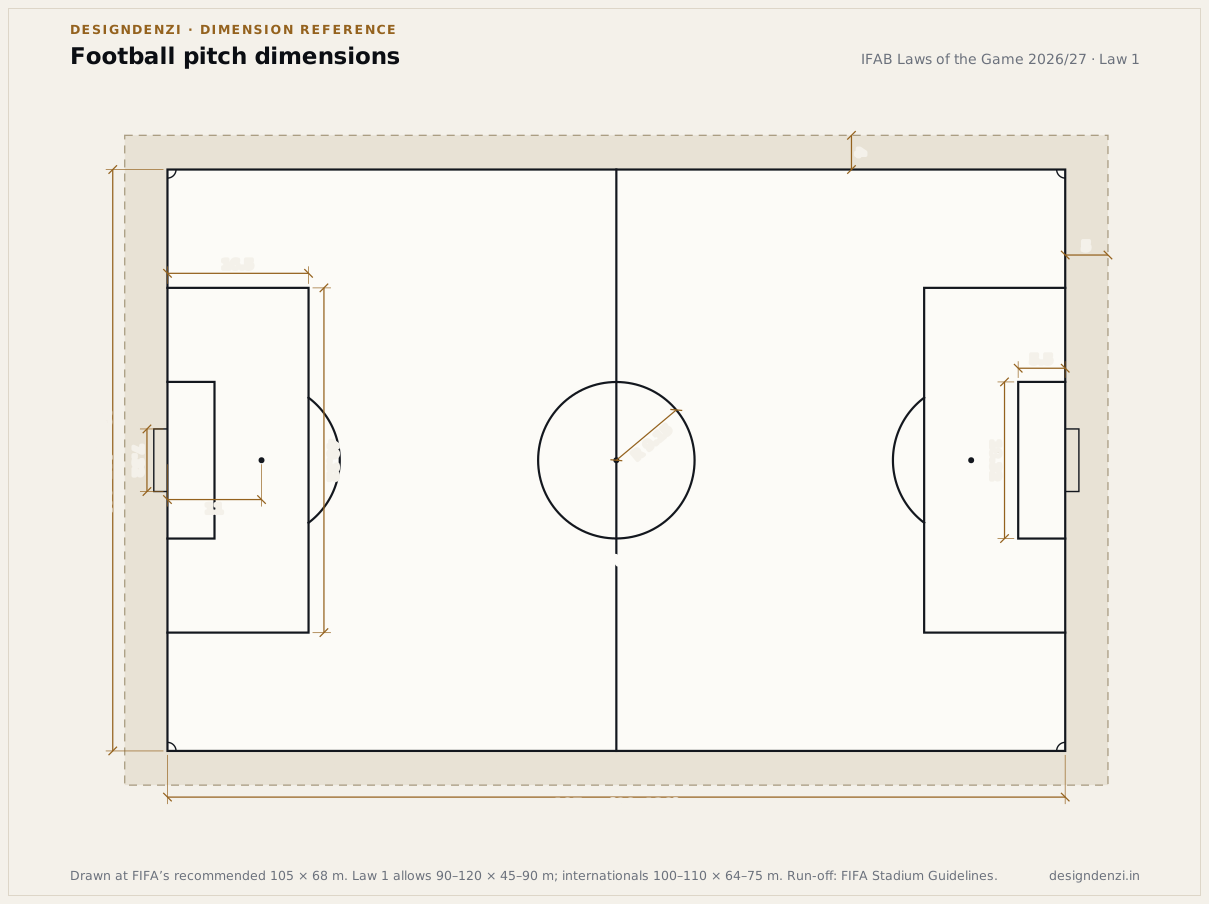
Key dimensions at a glance
| Element | Metric | Imperial | Reference |
|---|---|---|---|
| Touchline (length) | 90–120 m | 100–130 yd | Law 1.3 |
| Goal line (width) | 45–90 m | 50–100 yd | Law 1.3 |
| International matches | 100–110 × 64–75 m | 110–120 × 70–80 yd | Law 1.4 |
| FIFA recommended pitch | 105 × 68 m | — | FIFA Stadium Guidelines 5.3 |
| Goal (inside posts × underside of bar) | 7.32 × 2.44 m | 8 yd × 8 ft | Law 1.10 |
| Goal area depth / width | 5.5 m / 18.32 m | 6 yd / 20 yd | Law 1.5 |
| Penalty area depth / width | 16.5 m / 40.32 m | 18 yd / 44 yd | Law 1.6 |
| Penalty mark from goal line | 11 m | 12 yd | Law 1.6 |
| Centre circle and penalty arc radius | 9.15 m | 10 yd | Laws 1.2, 1.6 |
| Corner arc radius | 1 m | 1 yd | Law 1.7 |
| Line width | 12 cm max. | 5 in | Law 1.2 |
| Corner flagposts | 1.5 m min. | 5 ft | Law 1.8 |
IFAB states both units. The goal-area and penalty-area widths are our arithmetic from the Law 1 distances measured from the inside of each goalpost.
How the pitch is marked
The pitch is a rectangle; the touchlines must be longer than the goal lines, and every line is the same width, no more than 12 cm, with the goal lines as wide as the posts and crossbar. Lines belong to the areas they enclose, so measure to their outside edges.
- Goal area — lines 5.5 m from the inside of each goalpost, extending 5.5 m into the field.
- Penalty area — lines 16.5 m from the inside of each goalpost, extending 16.5 m into the field; the penalty mark is 11 m from the midpoint between the posts, with an arc of 9.15 m radius outside the area.
- Centre circle — 9.15 m radius. Optional marks off the field, 9.15 m from each corner arc, show the distance at corner kicks.
- Technical area — up to 1 m either side of the team seating and forward to 1 m from the touchline.
The surface may be natural, or artificial or hybrid where competition rules allow; artificial surfaces must be green, and for international matches must meet the FIFA Quality Programme.
Run-off and the land a pitch needs
The Laws set the pitch only. FIFA’s Stadium Guidelines recommend 5 m beyond each goal line and 4 m beyond each touchline before the advertising boards in larger stadiums, and 4 m and 3 m in smaller ones, with at least 2 m of level surface beyond every line. Around a 105 × 68 m pitch that gives an area of 115 × 76 m (larger stadiums) or 113 × 74 m (smaller) — our arithmetic.
On orientation, FIFA notes that north–south is the most common alignment and advises a sun-path study for each site. Land for the pitch is only the start: team and officials’ facilities, spectator provision, circulation and parking take more.
Futsal and small-sided football
| Futsal | Figure | Reference |
|---|---|---|
| Court length × width | 25–42 × 16–25 m | Law 1.3 |
| International matches | 38–42 × 20–25 m | Law 1.3 |
| Goal | 3 × 2 m | Law 1.9 |
| Penalty mark / 10 m mark | 6 m / 10 m | Laws 1.4–1.5 |
| Centre circle radius | 3 m | Law 1.2 |
| Line width | 8 cm | Law 1.2 |
Futsal is preferably played on wood; artificial turf is allowed only exceptionally, in domestic competitions. Source: FIFA Futsal Laws of the Game, 2025-26 edition. For five- and seven-a-side football, Law 1 sets no separate size; it allows national associations to modify the field size for youth, veterans, disability and grassroots football.
Figures that circulate but are wrong
- “The regulation size is 105 × 68 m.” That is FIFA’s recommendation for stadiums. The Laws give ranges.
- “Allow 125 × 85 m overall.” That comes from FIFA’s superseded 2011 technical recommendations. The current guidelines give 5 m and 4 m (or 4 m and 3 m) run-offs.
- “Lines are 12 cm.” 12 cm is the maximum, not a standard width.
- “The 2025/26 Laws are current.” The 2026/27 Laws have applied since 1 July 2026; Law 1 did not change.
- “A futsal court is 40 × 20 m.” Futsal sets ranges: 25–42 × 16–25 m (38–42 × 20–25 m for internationals).
What this means for a football ground or stadium
Fix the competition level first — it sets the pitch range, the run-off and the support schedule. Then orientation, drainage, spectator sightlines and egress, and the phasing that lets a training ground become a stadium without rebuilding it.
We plan grounds, academies and stadiums from these figures. See Football Stadium Design and How Much Land Does a Sports Complex Need?
Sources
- IFAB — Laws of the Game 2026/27, Law 1 (The Field of Play)
- IFAB — Law 1 online
- FIFA Stadium Guidelines — 5.3 Pitch dimensions and surrounding areas
- FIFA Stadium Guidelines — 2.2 Orientation
- FIFA Futsal Laws of the Game 2025-26 (as published by the AIFF)
- IFAB — 2026/27 changes to the Laws of the Game (none to Law 1)
- FIFA — Football Stadiums: Technical Recommendations and Requirements, 5th edition (2011; superseded)
Figures checked against these documents on 2 Oct 2026. Where a figure is our own arithmetic from official values, the text says so.
RelatedFootball Stadium Design · All court & ground dimensions · Hockey Field Dimensions · 400 m Running Track Dimensions