
Insights · Track dimensions
400 m Running Track Dimensions
A standard 400 m athletics track has two semicircular bends of 36.50 m radius joined by two 84.39 m straights, with lanes 1.22 m wide (±0.01 m). With eight lanes it measures 176.91 m by 92.52 m to the outside of lane 8 — before safety zones, field events and spectators. The lap is measured 0.30 m out from the inner kerb; the kerb itself is 398.116 m long. Source: World Athletics Track and Field Facilities Manual (2019 edition).
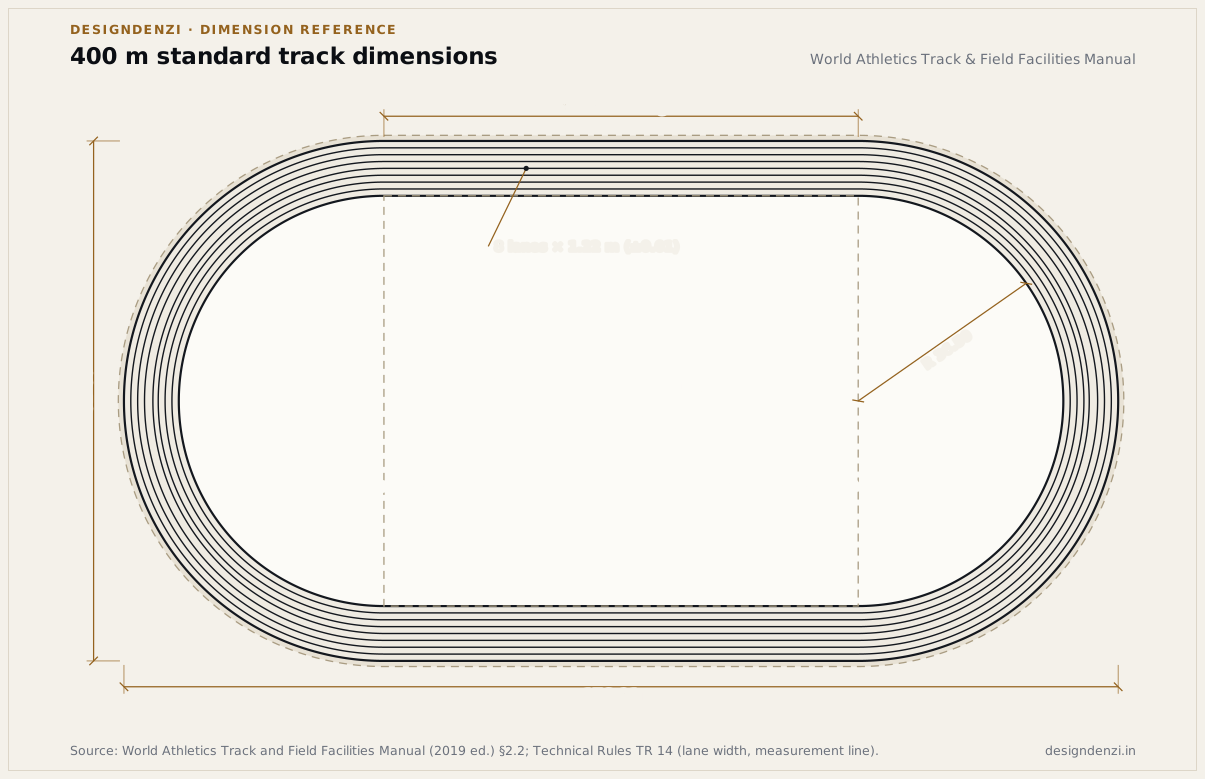
Key dimensions at a glance
| Element | Figure | Reference |
|---|---|---|
| Bend radius (to the inner edge) | 36.50 m | §2.2.1.1 |
| Straight | 84.39 m | §2.2.1.1 |
| Lane width, including the line on the right | 1.22 m ±0.01 | §2.1.1.1 |
| Lanes, Construction Category I (Olympic Games, World Championships) | 8 min. | Manual |
| Lane 1 measurement line | 0.30 m out from the kerb | Manual |
| Other lanes’ measurement line | 0.20 m from the outer edge of the lane inside | §2.2.1.1 |
| Length of the kerb edge | 398.116 m | §2.2.1.1 |
| Length along the lane 1 measurement line | 400.001 m | §2.2.1.1 |
| Overall, 8 lanes | 176.91 × 92.52 m | Fig. 1.2.3a |
| Infield rectangle | 84.39 × 73.00 m | Fig. 2.2.1.1a |
| Kerb height / width | 50–65 mm / 50–250 mm | Manual |
| Cross slope towards the inside, max. | 1% | Manual |
| Overall downhill slope, start to finish, max. | 0.1% | Manual |
References are to the World Athletics Track and Field Facilities Manual, 2019 edition (Chapters 1–3). The same figures appear in the Technical Rules.
The geometry, and why it cannot be compressed
Lane 1 is measured along a line 0.30 m outside the kerb — 36.80 m from the bend centres — which gives 400.001 m. The kerb edge itself is 398.116 m. Each outer lane is measured 0.20 m from the outer edge of the lane inside it, and because outer lanes run larger radii on the bends, starts in those races are staggered.
Because the lap length is fixed, the standard track is a fixed object: 176.91 × 92.52 m for eight lanes, with an 84.39 × 73.00 m infield inside the kerb. World Athletics also publishes “double-bend” variants with compound radii.
Safety zones and the land you actually need
The Manual requires an obstacle-free zone at least 1.00 m wide inside the track and recommends one at least 1.00 m wide outside it — 178.91 × 94.52 m overall, by our arithmetic. The sprint straight needs at least 3 m behind the start and at least 17 m of run-out beyond the finish, so the straight usually extends past the bend on one side.
Then come the field events, the warm-up, spectators and access. The Manual requires the land to be at least twice the net sports area, and if possible three times. Test a site against the full envelope, not the oval.
Field events
| Element | Figure | Reference |
|---|---|---|
| Long and triple jump runway | 40 m min. (45 m at major events) × 1.22 m | Manual §2.1.1.2, §2.3 |
| Long jump landing area | 2.75 m wide min. | Manual §2.3.1 |
| Triple jump board from the pit (international) | 13 m men / 11 m women min. | Manual §2.3.2 |
| High jump run-up radius | 15 m min. (25 m at major events) | Manual §2.3.3 |
| High jump landing area | 6 × 4 m min. | Manual §2.3.3 |
| Pole vault landing area | 6 × 6 m plus 2 m front extension | Manual §2.3.4 |
| Shot / discus / hammer circle diameter | 2.135 / 2.50 / 2.135 m | Manual §2.1.1.3 |
| Shot / discus / hammer sector radius | 25 / 80 / 90 m | Manual §2.1.1.3 |
| Javelin runway / sector radius | 30 m min. × 4 m / 100 m | Manual §2.1.1.3 |
| Steeplechase water jump | 3.66 × 3.66 m; 0.50 m (±0.05) at its deepest | Manual §2.2.4.1 |
The shot, discus and hammer sectors open at 34.92° (a chord of 0.6 × the radius — our arithmetic) and the javelin sector at 28.96°. Where discus and hammer share a cage, the Manual prefers concentric circles.
Certification
World Athletics certifies facilities, with Class 1 and Class 2 certificates for different levels of competition. Certification depends on construction accuracy and documented survey, so it is far cheaper to design for the intended class at concept stage than to retrofit a track that was not built for it.
Figures that circulate but are wrong
- “Lanes are 1.25 m wide.” 1.25 m was permitted only on tracks built before 2004, until resurfaced. The standard is 1.22 m ±0.01 m.
- “176.91 × 92.52 m is the land needed.” That is the outer edge of lane 8. Safety zones, field events and everything else come on top.
- “The kerb is 400 m.” The kerb is 398.116 m; the 400 m is measured 0.30 m outside it.
- “All throwing sectors are 34.92°.” Javelin is 28.96°.
What this means for a site
A 400 m track usually decides the master plan rather than sitting inside it: it needs a large rectangle with a strongly preferred orientation, and an infield that holds a full football pitch only if checked. We put the track on the site first, at full envelope, and plan around it — see Planning a 400 m Athletics Track and Athletics Track Design.
Sources
- World Athletics — Track and Field Facilities Manual, 2019 edition (Chapters 1–3)
- World Athletics — Book of Rules: Competition & Technical Rules (current edition)
- World Athletics — Technical information (facilities documents)
Figures checked against these documents on 2 Oct 2026. Where a figure is our own arithmetic from official values, the text says so.
RelatedAthletics Track Design · All court & ground dimensions · Planning a 400 m Athletics Track · Football Ground Dimensions