
Insights · Ground dimensions
Cricket Pitch & Ground Dimensions
A cricket pitch is 22 yards (20.12 m) long between the bowling creases — the lines through the stumps — and 10 ft (3.05 m) wide. The popping crease is 4 ft (1.22 m) in front of each set of stumps, so batters run 58 ft (17.68 m) between popping creases. The Laws do not fix the size of the ground. For men’s ODIs and T20Is the ICC requires a boundary between 65 and 90 yards (59.43–82.29 m) from the centre of the pitch in use. Pitch figures are from the MCC Laws of Cricket, 2017 Code 4th Edition (2026), in force since 1 October 2026; boundary figures from the ICC playing conditions of October 2026.
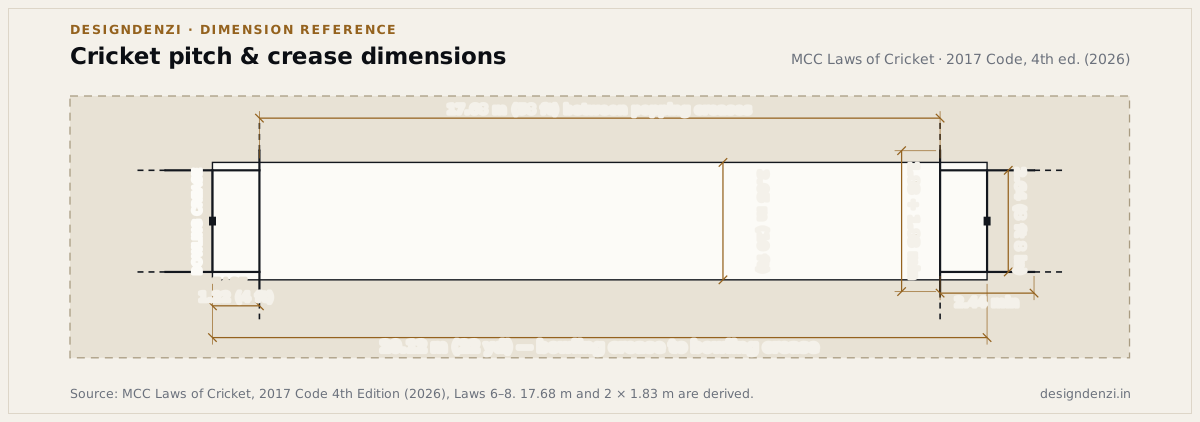
Pitch and creases at a glance
| Element | Metric | Imperial | Reference |
|---|---|---|---|
| Pitch length, bowling crease to bowling crease | 20.12 m | 22 yd | Law 6.1 |
| Pitch width | 3.05 m | 10 ft | Law 6.1 |
| Popping crease in front of the bowling crease | 1.22 m | 4 ft | Law 7.3 |
| Between the popping creases | 17.68 m | 58 ft | derived (22 yd − 2 × 4 ft) |
| Popping crease marked, each side of middle stump | 1.83 m min. | 6 ft | Law 7.3 |
| Bowling crease length | 2.64 m | 8 ft 8 in | Law 7.2 |
| Return creases, each side of middle stump | 1.32 m | 4 ft 4 in | Law 7.4 |
| Return crease, marked behind the popping crease | 2.44 m min. | 8 ft | Law 7.4 |
| Wicket width | 22.86 cm | 9 in | Law 8.1 |
| Stump height above the surface | 71.12 cm | 28 in | Law 8.2 |
| Stump diameter | 3.50–3.81 cm | 1.38–1.5 in | Law 8.2 |
| Non-turf pitch, minimum | 17.68 × 1.83 m | 58 × 6 ft | Law 6.5 |
The Laws are written in imperial with metric equivalents; the metric figures above are as printed. Junior pitch length and stump size are left to each national governing body.
How the pitch and creases are defined
The pitch is the rectangle between the two bowling creases, 10 ft wide — 5 ft either side of the line joining the middle stumps. The bowling crease runs through the centre of the stumps and is 8 ft 8 in long, with the wicket in its middle. The popping crease is 4 ft in front of it, marked for at least 6 ft either side of the middle-stump line and treated as unlimited in length. The return creases run back from the popping crease at right angles, 4 ft 4 in either side of the middle-stump line, marked for at least 8 ft behind it and also treated as unlimited.
The bowling and popping creases are measured to the back edges of their markings, and the return creases to their inside edges. Twenty-two yards is the distance between the bowling creases, not the popping creases — the commonest mistake in hand-drawn diagrams.
Stumps and bails
Each wicket is three stumps and two bails, 9 in (22.86 cm) wide, with the tops of the stumps 28 in (71.12 cm) above the playing surface. Stumps are 1.38–1.5 in in diameter; the bails may not project more than 0.5 in above the stumps, and each bail is 4.31 in (10.95 cm) long overall. The two wickets stand opposite and parallel to each other, centred on the bowling creases.
Boundary size and ground dimensions
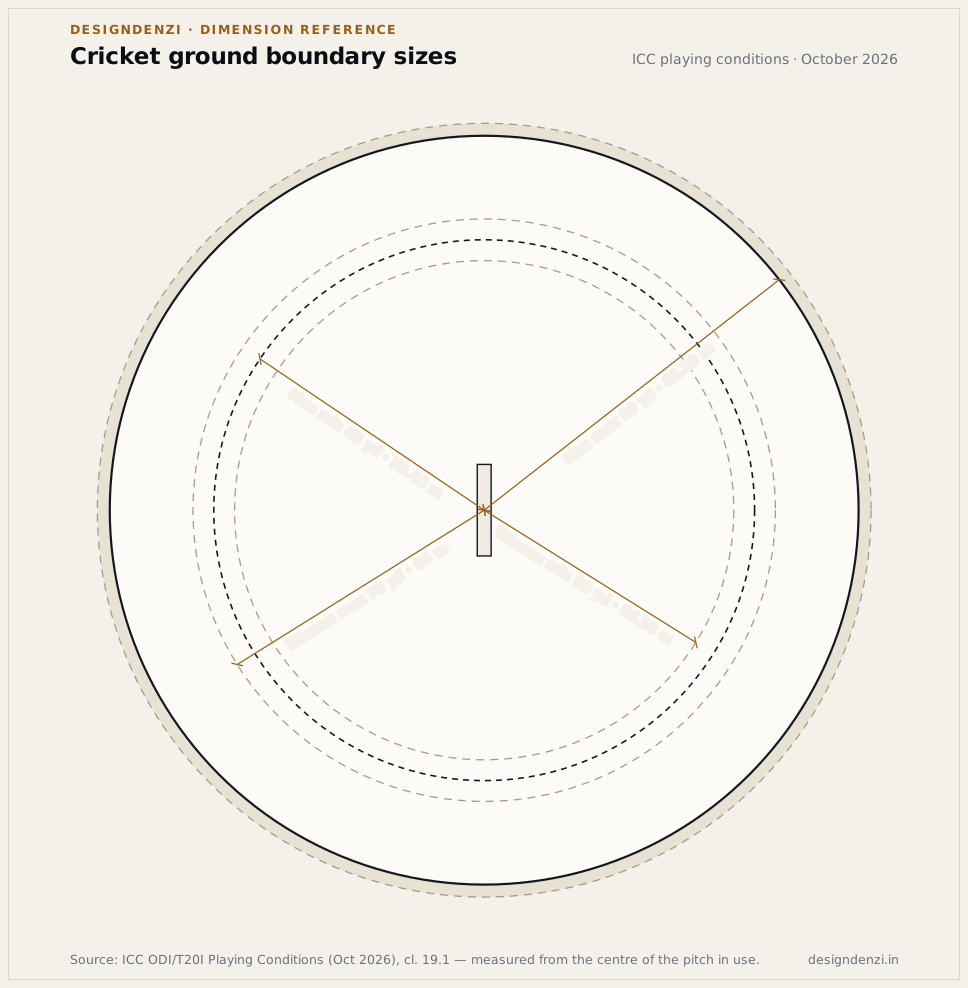
| Level | Yards | Metres | Reference |
|---|---|---|---|
| Men’s ODI and T20I | 65–90 yd | 59.43–82.29 m | ICC cl. 19.1.3 |
| Women’s ODI and T20I | 60–70 yd | 54.86–64 m | ICC cl. 19.1.3 |
| Run-off, rope to first solid object | 3 yd min. | 2.74 m | ICC cl. 19.1.4 |
| Rope to fence, where the boundary is under 90 yd | 10 yd max. | 9.14 m | ICC men’s cl. 19.1.5 |
| BCCI domestic T20 (2025-26): square, boundary to boundary | 140 yd min. | 128.01 m | BCCI cl. 19.1.3 |
| BCCI domestic T20 (2025-26): straight boundaries | 60 yd min. | 54.86 m | BCCI cl. 19.1.3 |
Boundaries are measured from the centre of the pitch in use, not from the centre of the ground, and the ICC asks venues to make the playing area as large as possible within the range. Exemptions apply to some existing grounds: the men’s conditions provide for grounds already approved for international cricket, and the women’s allow 55 yd (50.29 m) at grounds that hosted internationals, or were being designed or built, before November 2020. For BCCI domestic T20, the two square boundaries together must total at least 140 yd, with the shorter at least 60 yd, and sight-screens of 60 × 20 ft are required at both ends.
For land planning, a circular ground at the men’s minimum radius plus the 3 yd run-off covers about 1.2 ha (3 acres); at the maximum, about 2.3 ha (5.6 acres) — our arithmetic, before sight-screens, spectators, practice nets, the pavilion, service access and parking. Real grounds are rarely circles, which is why the boundary is set from the pitch in use.
Box cricket, junior and non-turf pitches
None of the governing-body documents cited here sets a size for box cricket, so there is no official figure to quote. For junior cricket, the Laws leave pitch length and stump size to the national governing body. A non-turf pitch must be at least 58 ft (17.68 m) long and 6 ft (1.83 m) wide.
Figures that circulate but are wrong
- “22 yards between the popping creases.” 22 yards is between the bowling creases. The popping creases are 58 ft apart.
- “The boundary is measured from the centre of the ground.” The ICC measures from the centre of the pitch in use.
- “The boundary is 65–90 metres.” Yards: 59.43–82.29 m.
- “The men’s range applies to women’s internationals.” Women’s internationals use 60–70 yd.
- “The MCC 3rd edition (2022) is current.” The 2017 Code 4th Edition (2026) has applied since 1 October 2026; the pitch and crease figures did not change.
What this means for a cricket ground
In our practice orientation comes first — we align the pitch roughly north–south so neither batter nor bowler faces a low sun — then the boundary radius for the level the client intends to host, then the land nobody counts: run-off, sight-screens, nets, the pavilion and spectator provision. Square preparation and outfield drainage decide whether the ground is playable after rain.
We plan grounds, academies and stadiums from these figures. See Cricket Ground Design, our Cricket Excellence Campus concept and How Much Land Does a Sports Complex Need?
Sources
- MCC — The Laws of Cricket, 2017 Code 4th Edition (2026), Laws 6–8 and 19
- ICC Men’s ODI Playing Conditions (October 2026), clause 19
- ICC Men’s T20I Playing Conditions (October 2026), clause 19
- ICC Women’s ODI Playing Conditions (October 2026), clause 19
- ICC Women’s T20I Playing Conditions (October 2026), clause 19
- MCC — Changes to the Laws for the 2026 edition, explained
- BCCI Playing Conditions for Men’s T20 Matches, Senior & Junior Domestic Tournaments 2025-26
Figures checked against these documents on 2 Oct 2026. Where a figure is our own arithmetic from official values, the text says so.
RelatedCricket Ground Design · All court & ground dimensions · Football Ground Dimensions · How Much Land Does a Sports Complex Need?