
Insights · Ground dimensions
Kho Kho Ground Measurement
A standard kho-kho field measures 27 m × 16 m. Two posts stand 24 m apart, joined by a 30 cm central lane, and a 1.5 m free zone lies behind each post. Eight cross lanes, each 35 cm wide, run across the field: 2.55 m from each post to the nearest cross lane and 2.30 m between neighbouring cross lanes. The posts are 120–125 cm high and 9–10 cm in diameter. The fast format of the Ultimate Kho Kho league is played on a smaller 22 × 16 m field.
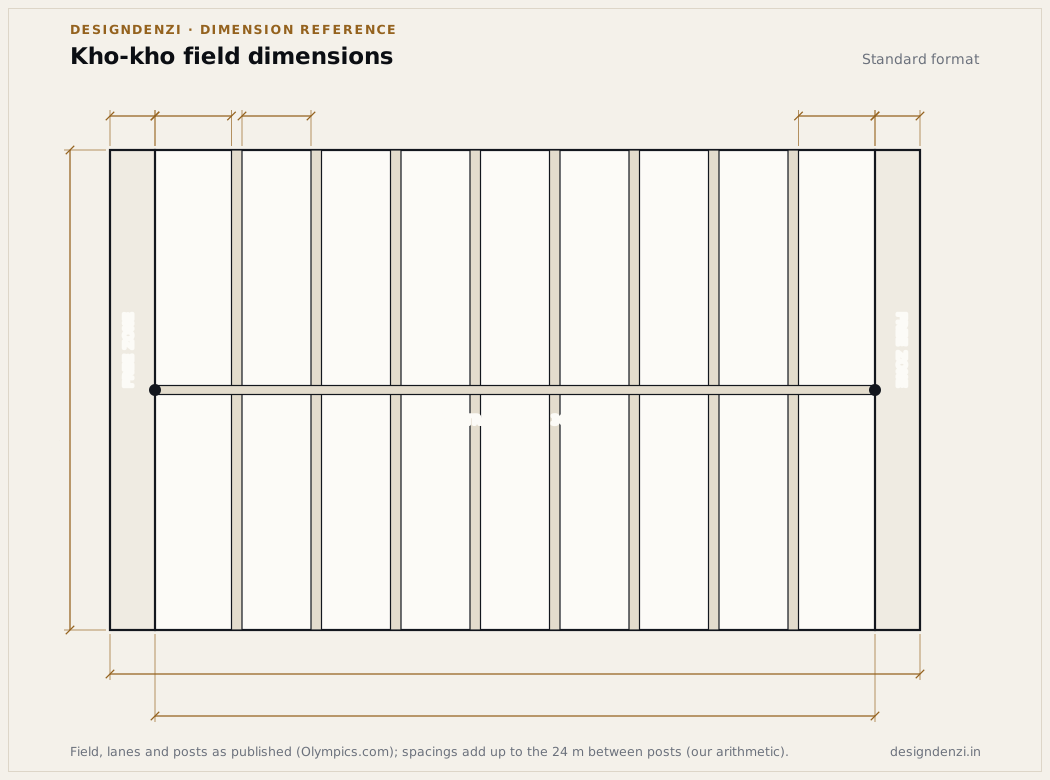
Field measurement chart
| Measurement | Standard format | Ultimate Kho Kho (league) |
|---|---|---|
| Field, length × width | 27 × 16 m | 22 × 16 m |
| Free zone at each end | 1.5 m deep | 1.5 × 16 m |
| Post to post (central lane length) | 24 m | 19 m |
| Central lane width | 30 cm | 30 cm |
| Cross lane width | 35 cm | 40 cm |
| Number of cross lanes | 8 | — |
| Post to nearest cross lane | 2.55 m | 2.55 m |
| Between neighbouring cross lanes | 2.30 m | 2.30 m |
| Posts | 120–125 cm high, 9–10 cm diameter | 120–125 cm high, 9–10 cm diameter |
| Overall ground | — | 26 × 20 m, with a 2 m lobby |
| Line width | — | 2–4 cm |
Standard format from Olympics.com and the kho-kho reference on Wikipedia. The spacings add up to the 24 m between the posts: 2 × 2.55 + 7 × 2.30 + 8 × 0.35 = 24.00 m (our arithmetic). League figures from the Ultimate Kho Kho Rules and Regulations. The Kho Kho Federation of India’s own rule book is not published online in full, so confirm figures against the current KKFI rule book before a court is built. A dash means the source does not give the figure.
How the field is laid out
The field is a rectangle with a post near each end. Behind each post is a free zone, 1.5 m deep across the full 16 m width, so the posts stand 24 m apart inside a 27 m field.
- Central lane — 30 cm wide, joining the foot of the two posts down the middle of the field and dividing it into two halves.
- Cross lanes — eight lanes, each 35 cm wide, running across the field at right angles to the central lane. Where they cross it, the seated chasers take their places.
- Spacing — 2.55 m from each post to the first cross lane, then 2.30 m between each pair of cross lanes.
- Posts — wood or metal, 120–125 cm high and 9–10 cm in diameter, fixed firmly and upright.
The Ultimate Kho Kho league field keeps the 16 m width and the 2.55 m and 2.30 m spacings but shortens the field to 22 m, with 40 cm cross lanes and a 19 m central lane.
What a national championship needs
KKFI’s competition guidelines for national championships (updated to November 2025) set out the venue rather than the court:
- Four grounds at the field of play, at least one of them a mat court, plus two practice grounds outside the arena.
- Grounds almost even and slightly raised at the centre, so that rainwater does not stand on them.
- A grass field of play, laid out east–west where practicable, and marked with white paint or lime powder.
- Lighting of at least 300 lux on each court for finals and 250 lux for league matches.
- Eighteen chairs at each end of the ground for players, reserves, coaches, managers and referees, and eight for technical officials.
Figures that circulate but are wrong
- “A kho-kho field is 22 × 16 m.” 22 × 16 m is the Ultimate Kho Kho league field. The standard field is 27 × 16 m.
- “Cross lanes are 40 cm wide.” 40 cm is the league specification. In the standard format each cross lane is 35 cm wide.
- “The field is 24 m long.” Twenty-four metres is the distance between the posts. The 1.5 m free zones behind them make the field 27 m long.
What this means for a kho-kho venue
A single court is a modest rectangle, but a championship venue is not. Four standard fields alone cover 4 × 27 × 16 = 1,728 m² before any space between them, seating, officials, practice grounds or circulation (our arithmetic). Orientation, drainage falls and the 300 lux lighting level for finals are planning decisions that are hard to change once a ground is laid.
We plan kho-kho and kabaddi courts, academies and arenas from these figures. See Kabaddi & Kho-Kho Arena Design, the Kabaddi Ground Measurement guide and our Kabaddi & Kho-Kho Sports Complex concept.
Sources
- Olympics.com — Kho Kho: history, rules and how to play
- Wikipedia — Kho kho (field, lanes and posts; Ultimate Kho Kho format)
- Kho Kho Federation of India — Competition Guidelines for Conducting National Kho Kho Championship, updated up to November 2025 (Ver 3.3)
- Ultimate Kho Kho — Rules and Regulations (Season 1)
- Kho Kho Federation of India — Rules & Regulations page
Figures checked against these documents on 19 Oct 2026. Where a figure is our own arithmetic from published values, the text says so.
RelatedKabaddi & Kho-Kho Arena Design · Kabaddi Ground Measurement · All court & ground dimensions · School Sports Infrastructure