
Insights · Court dimensions
Basketball Court Dimensions
A FIBA basketball court is 28 m long and 15 m wide, measured from the inner edge of the boundary lines. The three-point line is 6.75 m from the basket (0.90 m from the sidelines in the corners), the free-throw line is 5.80 m from the end line, and the ring is 3.05 m above the floor. FIBA also requires an unobstructed band at least 2 m wide around the court and 7 m of clear height. The figures below are from the FIBA Official Basketball Rules 2026, in force since 1 October 2026; the court is unchanged from the 2024 edition. The NBA plays on a larger 94 × 50 ft court.
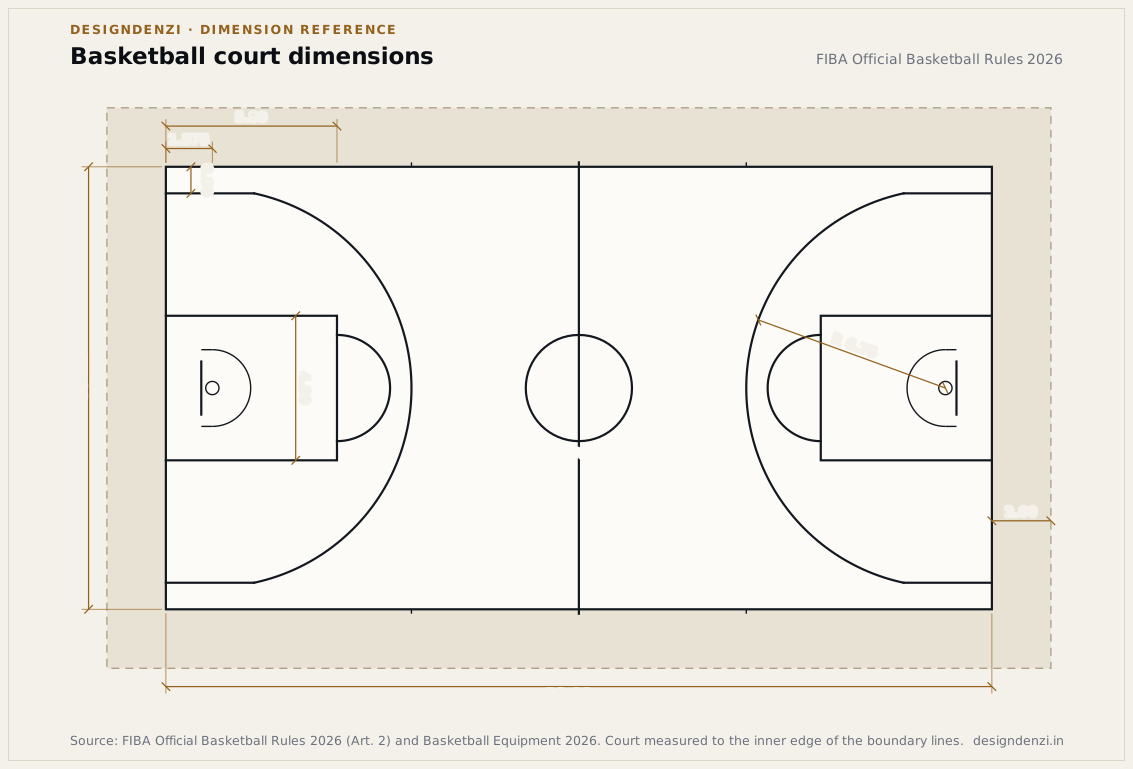
Key dimensions at a glance
| Element | Metric | Imperial | Reference |
|---|---|---|---|
| Court length × width | 28 × 15 m | ≈ 91 ft 10 in × 49 ft 3 in | Art. 2.1 |
| Floor including run-off | 32 × 19 m min. | — | Art. 2.2; Equipment 10.2 |
| Line width | 5 cm | ≈ 2 in | Art. 2.5 |
| Three-point arc radius | 6.75 m | ≈ 22 ft 2 in | Art. 2.5.4 |
| Three-point line from sideline (corners) | 0.90 m | ≈ 2 ft 11 in | Art. 2.5.4 |
| Basket centre from end line | 1.575 m | ≈ 5 ft 2 in | Art. 2.5.4 |
| Free-throw line from end line (far edge) | 5.80 m | ≈ 19 ft | Art. 2.5.3 |
| Free-throw line length | 3.60 m | ≈ 11 ft 10 in | Art. 2.5.3 |
| Restricted area (the key) | 4.90 m wide (2.45 m each side of centre) | ≈ 16 ft 1 in | Art. 2.5.3 |
| Centre circle and free-throw semicircles | 1.80 m radius | ≈ 5 ft 11 in | Art. 2.5.2 |
| No-charge semicircle | 1.30 m radius | ≈ 4 ft 3 in | Art. 2.5.7 |
| Ring height (top edge) | 3.05 m | 10 ft | Equipment 1.2.4 |
| Backboard | 1.80 × 1.05 m | ≈ 5 ft 11 in × 3 ft 5 in | Equipment 1.1.3 |
| Backboard face from end line | 1.20 m | ≈ 3 ft 11 in | Equipment 1.1.8 |
| Clear height above the court | 7 m min. | ≈ 23 ft | Equipment 11.4 |
FIBA works in metres; feet are conversions. Art. = FIBA Official Basketball Rules 2026; Equipment = FIBA Basketball Equipment 2026.
How the court is marked
The boundary lines are not part of the court: the 28 × 15 m is measured to their inner edges, and every line is 5 cm wide. The centre line runs 0.15 m beyond each sideline. The main markings:
- Three-point line — an arc of 6.75 m radius (to its outer edge) centred on the point on the floor directly below the centre of the basket, 1.575 m from the end line. It joins two straight lines parallel to the sidelines, 0.90 m from them, so in the corners the distance drops to as little as 6.60 m — our arithmetic, not a printed figure.
- Restricted area — a rectangle running from the end line to the free-throw line, its sides 2.45 m either side of the end line’s midpoint: 4.90 m wide. The older trapezoid key is no longer used.
- Free-throw line — 3.60 m long, its far edge 5.80 m from the inner edge of the end line. With the backboard 1.20 m in from the end line, that is 4.60 m from the face of the board (our arithmetic).
- No-charge semicircle — 1.30 m radius to its outer edge, under the basket, finished with short straight lines that end 1.20 m from the end line.
- Throw-in lines — four 0.15 m marks outside the court, two on each sideline, 8.325 m from the nearest end line.
Ring, backboard and height
The top of the ring is 3,050 mm (±6 mm) above the floor, with an inside diameter of 450–459 mm. The backboard is 1,800 × 1,050 mm with a 590 × 450 mm target rectangle whose base is level with the ring; its front face is 1,200 mm from the end line. Because the base of the target rectangle is level with the ring and 150 mm above the bottom of the board, the board’s bottom edge sits about 2.90 m above the floor (our arithmetic). The front of the backstop padding must be at least 2 m from the outer edge of the end line for FIBA’s top-level (Level 1) competitions and 1 m at Level 2.
FIBA requires at least 7 m from the court to the ceiling or the lowest obstruction. In a multi-use hall that will host higher-level badminton or volleyball, those sports usually set the height; basketball more often sets the footprint.
Run-off and the floor you actually need
The playing floor must be at least 32 × 19 m: the 28 × 15 m court plus an unobstructed band at least 2 m wide on every side. Nothing may stand within that band — including seated bench personnel — and seated spectators must be at least 2 m from the outer edge of the boundary lines. Floors are wood or glass at both FIBA levels; synthetic floors are allowed at Level 2 only.
In planning terms, the 32 × 19 m floor is the minimum box. Team benches, the scorer’s table (at least 6 m long, on a platform), circulation behind the benches and any spectator rows sit outside it.
FIBA and NBA
| Element | FIBA | NBA |
|---|---|---|
| Court | 28 × 15 m | 94 × 50 ft (28.65 × 15.24 m) |
| Three-point line | 6.75 m arc; 0.90 m from sidelines | 23 ft 9 in arc; 3 ft from sidelines |
| Free-throw line | 5.80 m from the end line | 15 ft from the backboard face |
| Restricted area | Rectangle, 4.90 m wide | Restricted-area arc 4 ft from the basket |
| Ring height | 3.05 m | 10 ft |
NBA figures are from the NBA Official Rules 2025-26, Rule No. 1; the court outline is defined on the NBA’s official court diagram.
Figures that circulate but are wrong
- “The three-point line is 6.25 m.” That figure is from older FIBA rules. It is 6.75 m.
- “The key is a trapezoid.” Also from older rules. The restricted area is a 4.90 m-wide rectangle.
- “The free-throw line is 5.80 m from the backboard.” It is 5.80 m from the end line — 4.60 m from the backboard.
- “The corner three is 6.75 m.” The straight sections are 0.90 m from the sidelines, so a corner shot can be as short as 6.60 m.
- “The 2024 rules are current.” The Official Basketball Rules 2026 have applied since 1 October 2026 (court unchanged).
What this means for a court or hall
An outdoor court needs the 32 × 19 m floor, level and drained, oriented so low sun does not run along the axis of play, with goal structures set back so the padding clears the end line. An indoor court adds the 7 m clear height, glare control and the support schedule — changing, storage, and seating that stays 2 m clear of the boundary.
We plan courts and halls from these FIBA figures at the level the client intends to host. See Basketball Court Design and Planning an Indoor Sports Hall.
Sources
- FIBA Official Basketball Rules 2026 (v1.1), in force 1 October 2026
- FIBA Basketball Equipment 2026 (v1.0)
- FIBA Official Basketball Rules 2026 — summary of rule changes
- NBA Official Rules 2025-26, Rule No. 1 — Court Dimensions, Equipment
Figures checked against these documents on 2 Oct 2026. Where a figure is our own arithmetic from official values, the text says so.
RelatedBasketball Court Design · All court & ground dimensions · Volleyball Court Dimensions · Badminton Court Dimensions · Planning an Indoor Sports Hall