
Insights · Court dimensions
Badminton Court Dimensions
A badminton court is 13.40 m long and 6.10 m wide, and the same rectangle is used for singles and doubles. Singles is played inside the inner sidelines, which narrow the court to 5.18 m. The net is 1.524 m high at the centre and 1.55 m at the posts, and every line is 40 mm wide. These figures come from Law 1 and Diagram A of the BWF Laws of Badminton. The court is unchanged in the edition in force since April 2025 (V5.0) and in the one that takes effect on 4 January 2027 (V6.0).
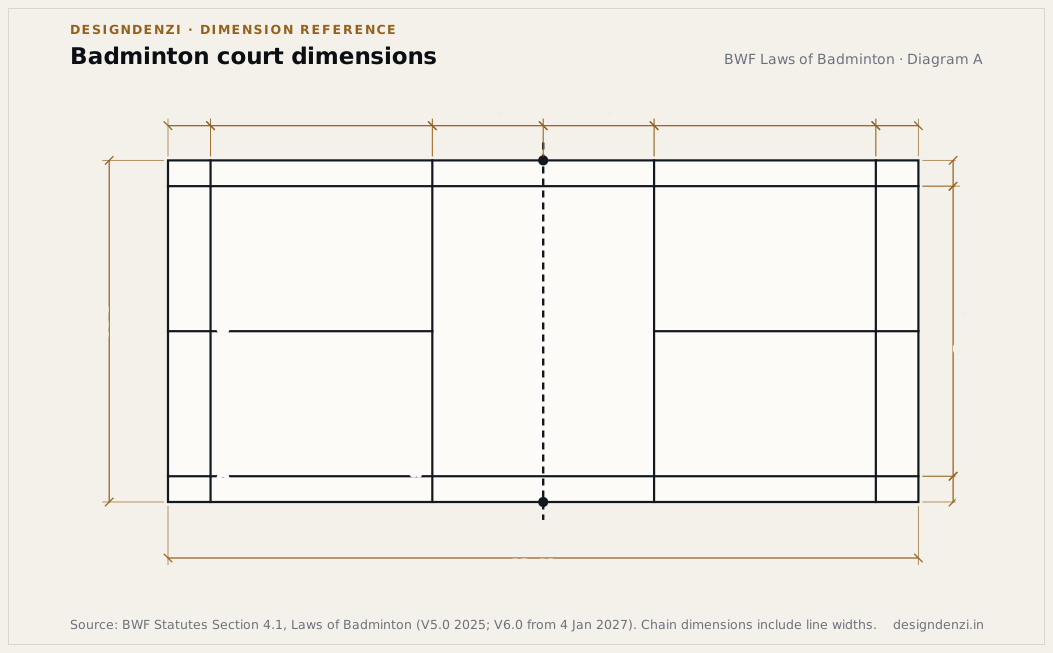
Key dimensions at a glance
| Element | Metric | Imperial | Reference |
|---|---|---|---|
| Court length | 13.40 m | ≈ 44 ft | Law 1, Diagram A |
| Court width, doubles | 6.10 m | ≈ 20 ft | Diagram A |
| Court width, singles | 5.18 m | ≈ 17 ft | Diagram A |
| Short service line from the net | 1.98 m | ≈ 6 ft 6 in | Diagram A |
| Doubles long service line, inside the back boundary | 0.76 m | ≈ 2 ft 6 in | Diagram A |
| Singles sideline, inside the doubles sideline | 0.46 m | ≈ 1 ft 6 in | Diagram A |
| Line width | 40 mm | ≈ 1½ in | Law 1.1 |
| Net height at the centre | 1.524 m | 5 ft | Law 1.10 |
| Net height over the doubles sidelines (posts) | 1.55 m | ≈ 5 ft 1 in | Laws 1.4, 1.10 |
| Net depth | 760 mm | ≈ 2 ft 6 in | Law 1.7 |
| Court diagonal (set-out check) | 14.723 m | ≈ 48 ft 4 in | Diagram A note |
The BWF publishes the court in metres only. Feet are conversions; “44 × 20 ft” is a rounding of 13.40 × 6.10 m, not a separate standard.
How Diagram A measures the lines
Lines are part of the area they bound (Law 1.3), so the 13.40 × 6.10 m outline is measured to the outside edges of the boundary lines. Diagram A then dimensions every line and gap. Working from the outside edge of a back boundary line towards the net, one half of the court is:
- 40 mm back boundary line, then 720 mm of court
- 40 mm doubles long service line, then 3.880 m to the short service line
- 40 mm short service line, then 1.980 m to the centre of the net — 6.70 m in all, or 13.40 m for the full court
Across the court the breakdown is 40 mm sideline, 420 mm, 40 mm singles sideline, 2.530 m, a 40 mm centre line, 2.530 m, 40 mm, 420 mm and 40 mm — 6.10 m in total. That is why planners quote the short service line at 1.98 m from the net, the doubles long service line 0.76 m inside the back boundary and the singles sideline 0.46 m inside the doubles sideline.
The BWF also prints the court diagonal: 14.723 m. Measuring both diagonals after marking out is the quickest way to prove a court is square — if they differ, the court is not a rectangle, whatever the side lengths say.
Singles and doubles: which lines apply
One court serves both games, so the lines do double duty:
- Singles — the inner sidelines bound the court; the back boundary line is also the singles long service line.
- Doubles — the outer sidelines bound the court. On the serve only, the doubles service court ends at the doubles long service line, 0.76 m inside the back boundary. Once the shuttle is in play, the full court applies.
- Centre line — runs from each short service line to the back boundary and divides the left and right service courts.
The BWF also permits a court marked for singles only, and the Laws include separate court diagrams for para badminton (wheelchair and standing classes).
Net and posts
The posts are 1.55 m high, stand on the doubles sidelines and must not intrude into the court. The net is 760 mm deep and at least 6.1 m wide, with a 15–20 mm mesh and a 75 mm white tape doubled over a cord or cable at the top. Its top edge sits 1.524 m above the surface at the centre and 1.55 m over the doubles sidelines, and there must be no gap between the ends of the net and the posts.
Where posts are impractical — a court marked over another sport, for example — the BWF permits thin posts or 40 mm strips fixed to the sidelines and rising vertically to the net cord to mark the sidelines’ position under the net.
Space around and above the court
The Laws stop at the lines. The clear height above the court, the clear space behind and beside it, the spacing between adjacent courts, lighting and air movement are set separately, by competition level, in the BWF’s Specifications for International Standard Facilities (Statutes Section 5.3.4; current edition V3.0, in force since 26 April 2026). Those figures apply to BWF-sanctioned events; for club, school and academy halls they are the reference to design towards, not a legal minimum.
Two things follow for any hall. First, height is the expensive decision: it is fixed by the structure and cannot be added later, so set it for the highest level the hall will ever host. Second, a court’s footprint is never just 13.40 × 6.10 m — budget the clear space at the ends and sides and between courts before the court count is fixed. Lights should sit beside the court rather than over it, and the walls behind the court ends should be dark so the shuttle stays visible.
Figures that circulate but are wrong
- “The net is 1.55 m high.” Only at the posts. At the centre it is 1.524 m.
- “The official size is 44 × 20 ft.” The BWF works in metres: 13.40 × 6.10 m. 44 × 20 ft is a rounded conversion — 44 ft is about 1 cm longer than 13.40 m.
- “Lines are measured to the centre.” Lines belong to the area they bound, so outer dimensions run to the outside edges.
What this means for a badminton hall
The court costs almost nothing; the building around it is the project. Clear height, run-off, the spacing between courts, glare and — above all — air movement decide whether a hall plays well, and all of them are fixed at concept stage. A shuttle is deflected by air moving across the court, which puts ventilation in direct tension with cooling in an Indian climate.
We set badminton halls out from the BWF figures for the level the client intends to host, then test court count against the operating model before any architecture is drawn. Read more in Badminton Court Design and Planning an Indoor Sports Hall.
Sources
- BWF Statutes, Section 4.1 — Laws of Badminton, V5.0 (in force 26 April 2025)
- BWF Statutes, Section 4.1 — Laws of Badminton, V6.0 (in force 4 January 2027; court unchanged)
- BWF Statutes index (current versions of each section)
Figures checked against these documents on 2 Oct 2026. Where a figure is our own arithmetic from official values, the text says so.
RelatedBadminton Court Design · All court & ground dimensions · Planning an Indoor Sports Hall · Basketball Court Dimensions · Volleyball Court Dimensions